
Video zur Finanzierung von Open-Access-Artikeln
Quelle: Brinken, H. (2020). Finanzierung von Open-Access-Artikeln, open-access.network. https://doi.org/10.5446/49536 (CC BY 3.0 DE)
Open Access in the Arts
In recent years, the arts disciplines have also increasingly taken a position on open access. Because they are situated between the arts and the sciences, they always play a special role in this regard.
The arts are characterised not only by a diversity of disciplines that work both artistically and academically, but also by an extremely diverse publishing landscape with actors from the areas of science, culture, education, and (creative) industry.
The diversity of the arts disciplines is also reflected in the broad range of publications, which may be text-based or non-text-based. Whether they be artist books, exhibition catalogues, photos, music/performance productions, or 3D-objects, these publications usually require consideration of numerous legal issues and are often a challenge for publishing platforms.
The currently existing infrastructures for open access publications are geared mostly towards text-based publications and are not adequate for the needs in the arts. The infrastructures in the area of research data, some of which already exist or are currently being developed, are important points of reference and are groundbreaking for open access infrastructures (not only) in the arts.
In addition, because of the close links with the creative industries, developments in the arts impact a new area for the open access community – namely, the economic livelihood of artists. Artists work both for cultural and educational institutions and in the culture industry; they are dependent on marketing their content; and their publications are financed only partly via royalties. Moreover, they are often members of collecting societies, and are limited in their freedom to freely license their works. An open access strategy in the arts must therefore include the safeguarding of artists’ incomes.
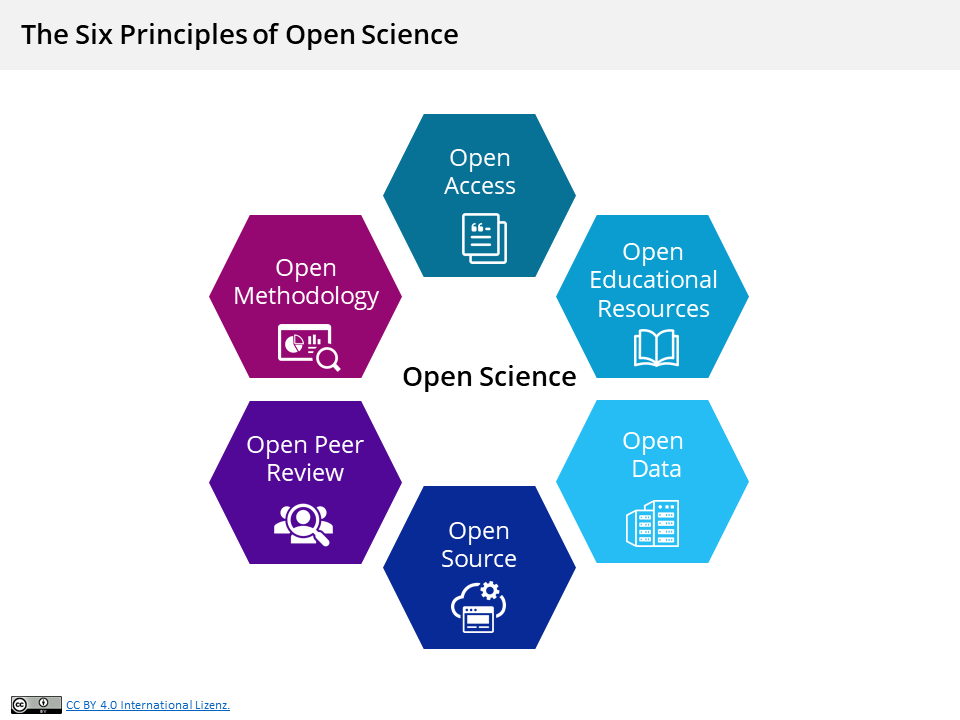
The arts disciplines already clearly show that open access must always be seen in the context of all building blocks of open science and of all actors.
Open Access Journals
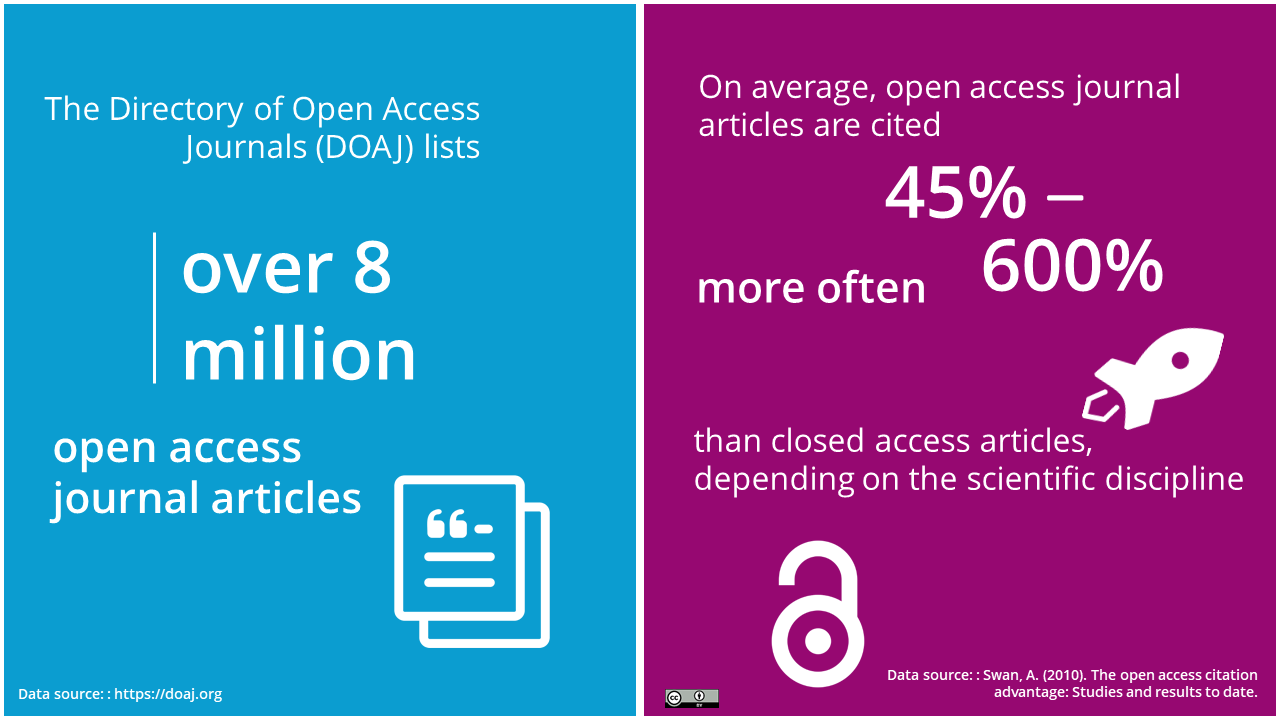
As of March 2024, the Directory of Open Access Journals (DOAJ) listed 627 entries under the keyword fine arts and 89 entries under music and books on music. The listed open access journals cater often for the arts-related scholarly disciplines but only rarely for the arts or artistic practice. In addition, journals are not the dominant form of publication in the arts disciplines.
Open Access Books
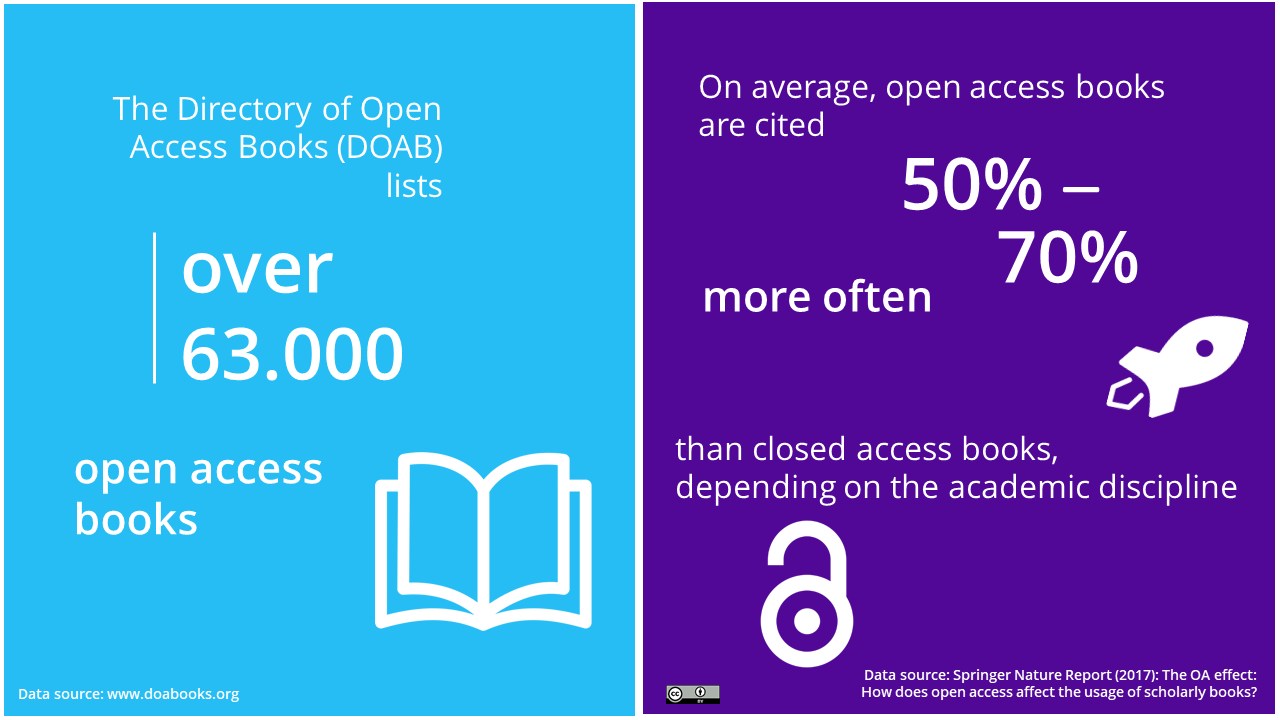
As of March 2024, the Directory of Open Access Books (DOAB) listed 169 titles under the keyword fine arts, while the OAPEN Library listed around 450 titles under art. However, the search results are mainly publications from the areas of art/art history or even ethnology rather than from the visual or applied arts.
In the last few years, the first open library consortia have been establishing themselves, for example the Open Library Medienwissenschaft since 2021 and KOALA Media Studies since 2023.
Disciplinary Repositories
The most important disciplinary repositories in the arts include:
- ART-Dok, the full-text server of the Specialised Information Service for Art, Photography and Design
- musiconn, the portal of the Specialised Information Service for Musicology
- media/rep/, an open access repository for media studies publications
The above-mentioned repositories are geared towards text-based publications.
The increasing importance of open access in the arts is also changing the disciplinary repositories: needs are being identified and new projects that deal with the building of repositories for non-text-based and multimedia media are arising.
An overview of relevant repositories is provided by the Open Directory of Open Access Repositories (OpenDOAR).
Video über das Zeitveröffentlichungsrecht
Quelle: Brehm, E. (2021). Zweitveröffentlichungsrecht für Wissenschaftler*innen, open-access.network. https://doi.org/10.5446/51789 (CC BY 3.0 DE)
Practical Tip
Finding Open Access Literature (in German)
Other Offerings
The network Open Access in den Künsten [Open Access in the Arts] offers all artistic institutions and higher education institutions a forum for exchange and discussion. The aim of the network is to share materials and information and to anchor the open access idea in the arts. The focus of the network is on libraries, which, as service facilities, promote and contribute to shaping the establishing of open access structures at various levels.
Open access is also gaining in importance in art and museum libraries (Hahn, 2018). Besides making text-oriented electronic resources available, these libraries have long been administering analogous special collections, such as image archives, graphical collections, or artist books. Here, open access can be a step towards digital transformation and the expansion of the collection profile and the information offering. Via synergy effects, this can also advance open access in the arts. For several years now, the Arbeitsgemeinschaft der Kunst- und Museumsbibliotheken (Working Group of the Art and Museum Libraries, AKMB) has offered further training in the area of open access.
Open Science in the Arts
Open science is also a key topic in the arts. The process of creating art, and also the works themselves, often move between several components of open science. In view of the diversity of the content and formats in the arts, it is therefore very expedient to focus not only on open access but also on open science as a whole, including, for example, open research data.
Besides the open access infrastructures, the offerings of cultural institutions and research data infrastructures also offer points of reference. The expertise that exists in NFDI4Culture and other representatives of the GLAM sector (galleries, libraries, archives, museums) is a valuable support for the arts in establishing publication infrastructures.
NFDI4Culture is a consortium within the German National Research Data Infrastructure (NFDI) that represents the art history, musicology, theatre, dance, architecture, film, and media studies communities. The aim of the consortium is to establish a range of offerings such as advisory and training services, guidelines, and forums for discipline-specific exchange. Moreover, NFDI4Culture engages with the legal complexities of dealing with cultural heritage, for example with questions of provenance or copyright.
References
- Hahn, C. (2018). Open Access im Museum. Herbstfortbildung AKMB Dresden. https://www.initiativefortbildung.de/pdf/schlaglichter_AKMB2018/Hahn_OA_Museum.pdf
Further reading
- Somajni, Chiara; Tóth-Czifra, Erzsébet; Barbieri, Chiara; Marazza, Suzanna and Pensa, Iolanda (2024). Open Science for Arts, Design andMusic: Guidelines for Researchers, Librarians and Practitioners in the Humanities. SUPSI, CC0 1.0 except where otherwise stated. DOI: 10.5281/zenodo.13896781
Content editors of this page: Anika Wilde (Hochschule für Schauspielkunst Ernst Busch) and Friederike Kramer (Library of the Berlin University of the Arts, UdK) (Last updated: July 2024)